Florida Door Refinishing Team
Senior Coastal Restoration Specialists · FL.DoorStain
⏱ 9 min read · Published August 2026 · Bay Harbor Islands, FL
🛡️ Licensed & Fully Insured | ⭐ 5.0 Rated (13 Google Reviews) | 🏛️ HOA & ARC Approval Experts | 🌴 Salt-Air & UV Weatherproofing | ⚡ Free On-Site Estimates | Rapid Response in Bay Harbor Islands
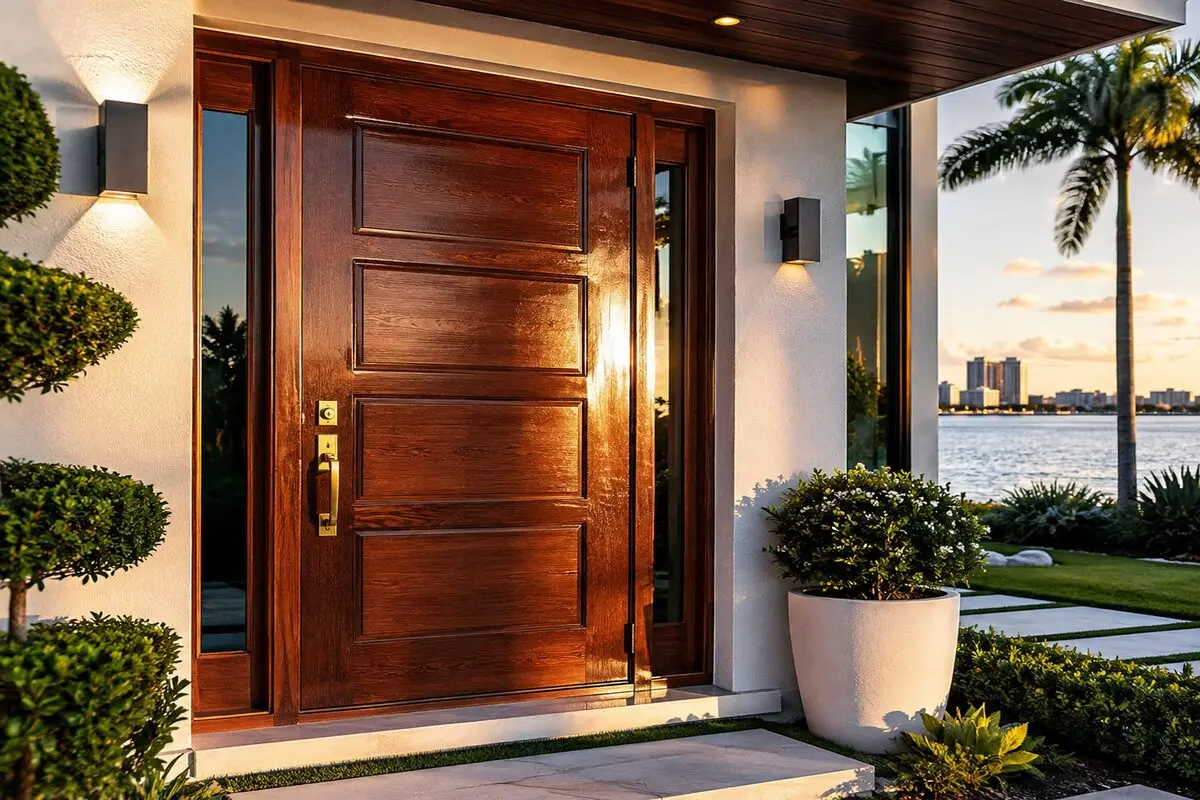
Bay Harbor Islands is not a place where a homeowner can simply repaint a front door on a whim. Between Broadview Island and Bay Harbor Island, the town’s individual condominium associations and single-family HOAs — Bay Harbor One, Bay Harbor Club, Evening Star, The Ivory Residences, and dozens of smaller boards — each maintain their own Architectural Review Committee, and most require prior written approval before an owner touches an exterior door finish. Add in the town’s position on two barrier islands surrounded by Biscayne Bay, and you have a door-refinishing job that is equal parts craftsmanship and paperwork. Florida Door Refinishing & Wood Restoration has built its Bay Harbor Islands process around both halves of that equation: museum-quality finish work, and a documentation trail your board will actually accept on the first submission.
This page walks through what door refinishing looks like specifically in Bay Harbor Islands — the salt-air and humidity math unique to a town incorporated on filled bay bottom in 1947, the HOA approval workflow, real project pricing, and the exact steps our crew follows from first inspection to final coat. Homeowners weighing options across the region can also review our core door refinishing service overview for the general process before diving into the island-specific detail below.
Why Bay Harbor Islands Doors Fail Faster Than Inland Miami-Dade Doors
Bay Harbor Islands sits almost entirely surrounded by water — Biscayne Bay to the east, the Indian Creek waterway to the west — which means every exterior door on the island absorbs a level of airborne salt that homes ten miles inland never see. Wood front doors on waterfront lots along East and West Bay Drive typically show visible finish breakdown in eighteen to twenty-four months versus the four-to-six-year lifespan a comparable door gets in a non-coastal Miami-Dade neighborhood. Salt crystals are hygroscopic, meaning they pull moisture directly out of the surrounding air and hold it against the door’s surface even on dry days, which accelerates both the breakdown of exterior-grade polyurethane topcoats and the swelling of the wood substrate underneath.
Talk to Our Experts – Free Consultation
Humidity compounds the problem. South Florida’s relative humidity regularly sits above 75 percent for most of the year, and on the islands that number climbs further because of the surrounding open water. A door finished with an inland-grade sealer will trap moisture inside the wood fibers rather than letting the door breathe, which is the single most common cause of the cupping and delamination we see on service calls in this town. Our approach uses a marine-spec, UV-stable topcoat formulated for direct salt-air exposure — the same product category used on boat brightwork — rather than a standard residential exterior varnish, because a standard product will not hold up on a door facing open bay water. Homeowners further inland who want the same finish system without the full marine specification can compare notes on our Miami door refinishing page, where humidity is the primary concern rather than direct salt spray.
| Environmental Factor | Bay Harbor Islands (Waterfront) | Inland Miami-Dade | Refinishing Impact |
|---|---|---|---|
| Airborne salt exposure | Continuous, both islands surrounded by bay | Minimal to none | Standard sealers fail 2–3x faster |
| Average relative humidity | 78–85% seasonal peak | 65–72% seasonal peak | Higher risk of cupping and delamination |
| UV exposure (east-facing bay doors) | Reflected UV off open water increases intensity | Standard direct UV only | Requires UV-stable, marine-grade topcoat |
| Typical finish lifespan | 18–24 months (standard finish) | 48–72 months (standard finish) | Marine-spec finish extends to 36–48 months on the islands |
| HOA/ARC approval required | Yes — nearly every association on both islands | Case by case | Documentation package needed before work starts |
Navigating Bay Harbor Islands HOA and Architectural Review Approval
If you own a unit at Bay Harbor One, Bay Harbor Club, Evening Star, or The Ivory Residences, or a single-family home under one of the smaller island associations, your governing documents almost certainly require Architectural Review Committee sign-off before any change to an exterior door’s color, sheen, or hardware. This is not a formality unique to a handful of buildings — it is close to universal across the town, and boards enforce it specifically to protect the cohesive, modern waterfront aesthetic that keeps property values on the islands among the highest in Miami-Dade County.
Our team builds the ARC submission packet as part of every free quote for Bay Harbor Islands, at no extra charge. That packet typically includes a written scope of work, the specific product data sheet for the topcoat we intend to use (boards frequently want to confirm sheen level and UV rating), and before photos of the existing door. We have submitted packets to enough of the island’s associations that we already know which boards want a color sample chip physically mailed versus a digital PDF, and which require a 30-day review window versus a 10-day expedited track. Getting this step wrong is the single most common reason a homeowner-initiated refinishing project stalls for a month or more; getting it right on the first pass is largely a matter of knowing each board’s specific submission quirks in advance.
For owners on Broadview Island specifically, several associations also require that any change be visually consistent with adjacent units when doors face a shared courtyard or marina walkway — something our estimator flags during the initial walk-through so there are no surprises after the ARC approves the color. Owners who also manage rental or vacation properties elsewhere in the county can find the same level of board-specific detail on our West Palm Beach location page.
Our Bay Harbor Islands Door Refinishing Process
Step one is an on-site inspection, not a phone estimate. Because so much of the pricing and timeline on this project depends on how much salt and moisture damage has already occurred beneath the surface, we physically test the door with a moisture meter and inspect the bottom rail and lock stile — the two areas where water intrusion shows up first on a bay-facing door.
Step two is the ARC documentation packet, described above, which we prepare and submit on the homeowner’s behalf whenever the association allows a vendor to submit directly, or hand over ready-to-file when the board requires the unit owner to submit personally.
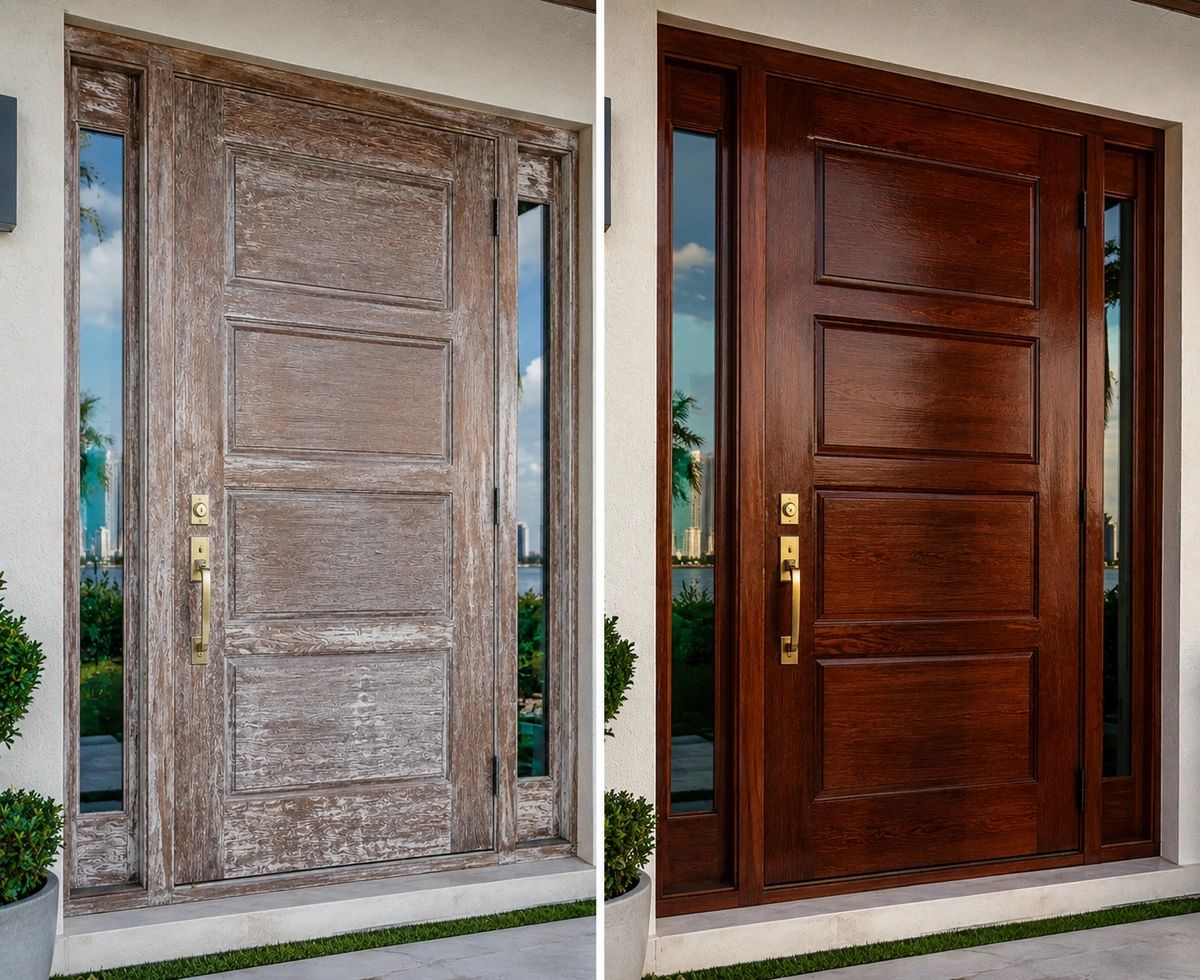
Step three is stripping and prep. We remove all existing finish down to bare wood using a controlled chemical stripping process rather than aggressive sanding, which preserves panel detail on the door’s raised molding — a detail that matters on Bay Harbor Islands’ older 1950s and 1960s Miami Modern homes where doors often carry decorative millwork that heavy sanding would round off.
Step four is repair. Any soft or water-damaged wood identified in the moisture-meter inspection is cut out and dutchman-repaired with matched-grain wood, not filled with epoxy alone — epoxy fill on a door facing direct bay humidity has a materially shorter lifespan than a proper wood splice.
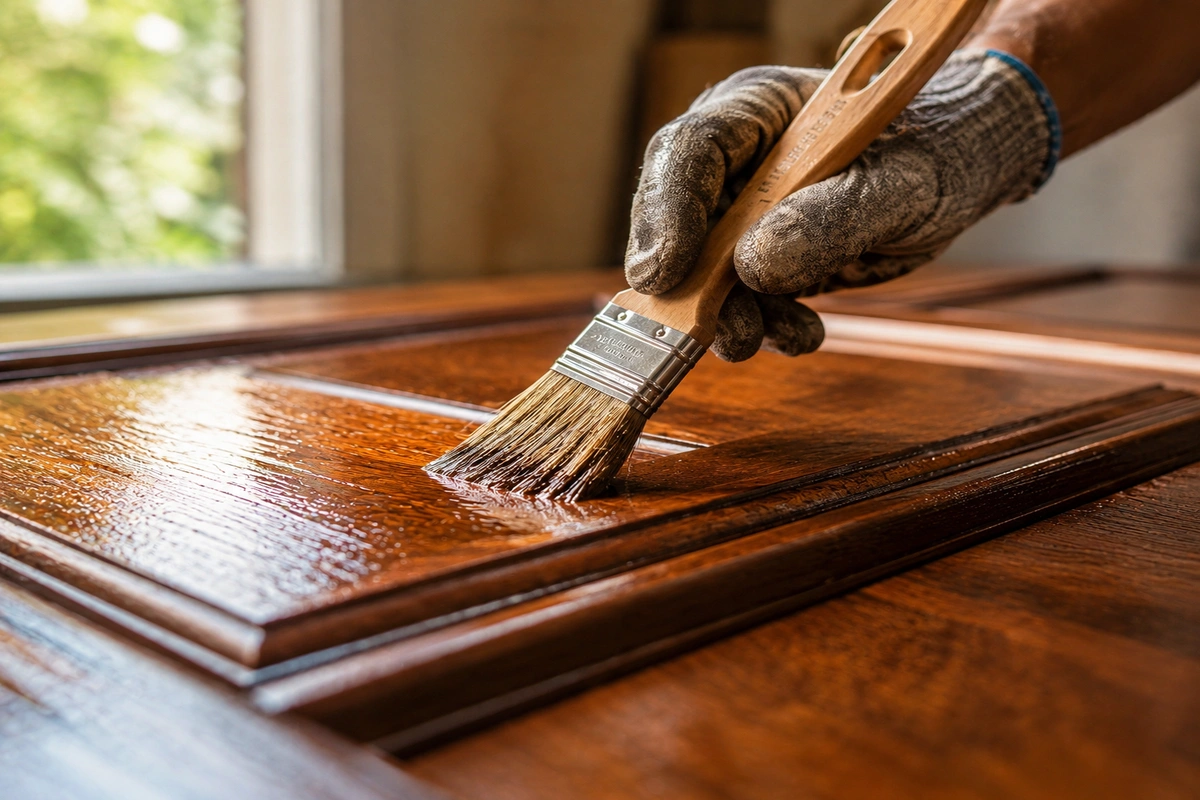
Step five is staining and sealing, using the marine-spec topcoat referenced above, applied in the number of coats the door’s sun and salt exposure calls for — typically four to six coats on a west-facing Indian Creek door versus three to four on a more sheltered interior-lot door.
Step six is final inspection and hardware reinstallation, including a walkthrough with the homeowner to confirm the finish matches the ARC-approved sample. Homeowners who also need their door’s paint film addressed rather than a full stain-and-seal system can ask about our door painting service as an alternative or complementary scope.
What Door Refinishing Costs in Bay Harbor Islands
Pricing on the islands runs slightly above our county-wide average, driven by the marine-spec topcoat and the additional labor built into ARC documentation. Every quote is free and based on an in-person inspection — the table below outlines the factors that determine the final cost for each service.
| Service | Pricing Basis | What’s Included |
|---|---|---|
| Single front door refinish | Base project rate | Strip, moisture inspection, marine-spec stain and seal, ARC documentation |
| Front door with sidelights | Base rate + glass complexity | Matching finish across door and glass-panel sidelight frames |
| French or double-door entry | Calculated per door leaf | Both leaves stripped and refinished, hardware removed and reinstalled |
| Wood repair / dutchman splice | Priced per damaged section | Matched-grain repair for water-damaged rail or stile sections |
| Garage door refinishing | Varies by square footage | Marine-spec exterior finish for wood or wood-composite garage doors |
For a like-for-like comparison, homeowners seeking door refinishing Bal Harbour and door refinishing Golden Beach face a similar salt-air premium on their quotes, while inland communities needing door refinishing Miami Shores typically see lower pricing because the finish system doesn’t need to be rated for direct bay-water exposure.
Real Reviews From Florida Door Refinishing Customers
★★★★★ Hamidrezs Khosdaman — 1 review
“I saw their work on Yelp and reached out to get my antique front door refinished. I was so impressed by how they handled the restoration. It looks amazing, and I can tell they really care about their work.”
★★★★★ Hasnain Khan — 2 reviews, 2 photos
“I choose this company to refinish my front door and garage door they are doing very hard work and amazing job so far my door look very nice.”
★★★★★ EngMaster EngMaster — 1 review
“Looking for a fresh look? DoorStain specializes in door restoration services that will give your home a polished, inviting appearance.”
These reviews reflect the same crew and process used on Bay Harbor Islands projects. Homeowners who want to see finished work on comparable waterfront wood doors can also browse the Fort Lauderdale project gallery, where several similar marine-exposure jobs are documented.
Materials That Actually Hold Up on Broadview and Bay Harbor Island
Not every wood species and finish combination is worth specifying on a barrier-island door. Mahogany and teak both perform well here because their natural oil content resists moisture intrusion better than oak or fir, which is why we recommend mahogany as a repair-wood match whenever the original door species allows it. For the topcoat itself, a two-part marine polyurethane outperforms single-part exterior varnish specifically because of its cross-linked molecular structure, which resists the constant expansion-and-contraction cycle caused by daily humidity swings on the bay.
Hardware matters just as much as the wood finish. Standard exterior door hardware — hinges, kick plates, thumb-latches — corrodes visibly within a year on a Bay Harbor Islands door unless it is rated 316 marine-grade stainless steel, the same specification used on boat deck hardware. We flag hardware condition during every inspection and, where an association’s ARC guidelines allow homeowner discretion on hardware (many do, even when they control door color strictly), recommend the upgrade at the time of refinishing rather than waiting for premature corrosion to force a second service call. Homeowners who want to see the reviews behind these recommendations can read our customer reviews page for more feedback from recent projects.
Refinishing vs. Replacement: When a Bay Harbor Islands Door Is Worth Saving
Not every door that looks tired on a Bay Harbor Islands home actually needs to be replaced, and the decision matters more here than in most Florida markets because a full door replacement on a barrier island almost always triggers a more involved ARC submission than a straightforward refinish. Boards that will approve a refinish through an expedited 10-day track frequently require the full 30-day review — sometimes with an architect’s letter — for a replacement, since a new door changes the unit’s dimensions, hardware sightlines, and sometimes its hurricane-impact rating documentation.
Our rule of thumb after inspecting hundreds of South Florida doors: if the moisture meter reads dry core wood beneath the surface damage, and the door’s structural joinery — the mortise-and-tenon or dowel construction holding the rails and stiles together — is still tight, refinishing is almost always the better investment. A well-built solid mahogany or teak door that has simply lost its finish to salt and sun can come back to better-than-new condition for a fraction of replacement cost, and without triggering the longer approval cycle. Replacement becomes the right call only when we find rot that has migrated into the door’s core structure, when the door has been improperly repaired in the past with non-marine-grade filler that has since failed, or when the homeowner wants a different door style entirely rather than a restoration of what’s already there.
This distinction is especially relevant on Bay Harbor Islands because so many of the town’s original 1950s and 1960s Miami Modern homes still carry their builder-original solid wood doors — doors that were built to a construction standard rarely matched by mass-produced replacement doors sold today. Owners weighing the same decision on a historic property elsewhere in the county can find a closely related discussion on our Boca Raton location page. Refinishing one of these original doors, rather than replacing it with a modern pre-hung unit, is often both the more cost-effective choice and the choice that best preserves the home’s architectural character, which matters directly to resale value in a town where architectural cohesion is central to the HOA culture.
Seasonal Timing for Door Refinishing Projects on the Islands
South Florida’s climate calendar affects how a refinishing project actually goes, and Bay Harbor Islands’ open-water exposure makes timing even more relevant than it would be inland. The dry season, roughly November through April, gives the marine-spec topcoat the best possible cure conditions — lower humidity means each coat sets up fully before the next is applied, which directly affects how long the finish will last. Projects scheduled during this window typically need fewer total coats to reach full protection because the wood substrate itself carries less ambient moisture going into the process.
Wet season work, June through October, is not off the table, but it does require adjustments. We schedule stripping and staining around forecasted rain windows rather than a fixed calendar, and we frequently recommend an additional topcoat pass for projects that must run during peak humidity months, simply to compensate for slower cure times. Hurricane season also affects ARC scheduling — several island associations pause non-essential exterior modification approvals during an active storm watch, which is a factor our estimator checks before committing to a timeline for a wet-season project.
For homeowners with flexibility, late fall through early spring remains the ideal window both for finish performance and for HOA processing speed, since board meeting schedules and committee availability tend to be more consistent outside of the summer travel season that many Bay Harbor Islands part-time residents follow. If you’re ready to lock in a dry-season slot, our contact page has the fastest way to reach our scheduling team directly.
Comparing Bay Harbor Islands to Nearby South Florida Communities
| Community | Primary Refinishing Challenge | Approval Process |
|---|---|---|
| Bay Harbor Islands | Direct bay-water salt exposure on two islands | Near-universal HOA/ARC approval requirement |
| Bal Harbour | Oceanfront salt spray plus high-rise wind load | Condo board approval, often building-managed |
| Golden Beach | Direct Atlantic exposure, minimal tree buffer | Town design review for street-facing changes |
| Key Biscayne | Combined bay and ocean salt exposure | Village design guidelines for historic-district homes |
| Miami Shores | Humidity without direct salt spray | Historic Preservation Board for designated homes |
Owners relocating between these markets, or managing property in more than one, often ask how the process differs. The short answer is that the wood science and finish chemistry stay largely consistent across coastal Miami-Dade, but the approval workflow changes meaningfully from town to town — which is why our estimators are trained on each municipality’s specific process rather than applying a single generic script. Homeowners comparing options across the county can review our Aventura door refinishing page or the Key Biscayne page for the town-specific breakdowns of those approval processes.
Frequently Asked Questions
Does my Bay Harbor Islands HOA really require approval for a door refinish, or just a full color change? Nearly every association on both islands — including Bay Harbor One, Bay Harbor Club, and Evening Star — requires ARC approval for any exterior door modification, including a refinish that keeps the same general color family. Sheen level and topcoat type are frequently reviewed as closely as color itself, since a glossier finish can visually change how a unit reads from the street or marina walkway.
How long does the ARC approval process typically take? It varies by association. Some boards run a 10-day expedited track for like-for-like refinishing projects, while others require the standard 30-day review used for any exterior modification. We build the expected timeline into the project schedule once we know which association governs your property.
Will a marine-spec finish actually outlast a standard exterior finish on my Bay Harbor Islands door? Yes. In direct comparisons on the islands, we typically see 36–48 months of service life from a properly applied marine-spec, two-part polyurethane topcoat versus 18–24 months from a standard single-part exterior varnish, given the identical salt and humidity exposure.
Can you refinish a door on Broadview Island if it faces a shared courtyard governed by multiple adjoining owners’ preferences? Yes — our estimator flags this during the initial walkthrough and confirms with the ARC whether visual consistency with neighboring units is a formal requirement or a soft preference before the color is finalized.
Do you repair water damage, or only refinish the surface? Both. Every inspection includes a moisture-meter check of the bottom rail and lock stile, and any soft wood is cut out and dutchman-repaired with matched-grain wood rather than surface-filled, since surface fill does not hold up to Bay Harbor Islands’ humidity levels.
Is garage door refinishing available for Bay Harbor Islands homes? Yes. Wood and wood-composite garage doors on the islands face the same salt and UV exposure as front doors and are finished with the same marine-spec topcoat system. See our garage door refinishing service page for scope details.
What does a typical Bay Harbor Islands quote take into account that an inland quote wouldn’t? Salt and humidity exposure rating for the finish system, ARC documentation preparation, hardware corrosion assessment, and — where relevant — visual consistency requirements with adjoining units on shared courtyards or marina-facing walkways.
Free Quote — Upload Photos of Your Door
Submit a few photos of your door and our estimator will follow up with pricing and an ARC-ready scope of work, typically within one business day. There is no cost or obligation for this quote.
Get Your Free Bay Harbor Islands Quote
Photos help us give you an accurate estimate before we even step on site.